
Class 9 · Kaushal VikasNCERT 2026 Revised Syllabus
Chapter 5: Shaping Materials (0907KV05)
Section 5.3 – Choosing Material for a Specific Product — 1 questions with step-by-step answers.
Jump to:
All ExercisesSection 5.2 – Processing Material: Transformation to a ProductSection 5.3 – Choosing Material for a Specific ProductSection 5.4.1 – Following Safety ProtocolSection 5.4.2 – Taking MeasurementsSection 5.4.3 – Making Technical DrawingsSection 5.7 – Assess Your LearningHands-On Tasks — How to Do
Section 5.3 – Choosing Material for a Specific Product(1 questions)
1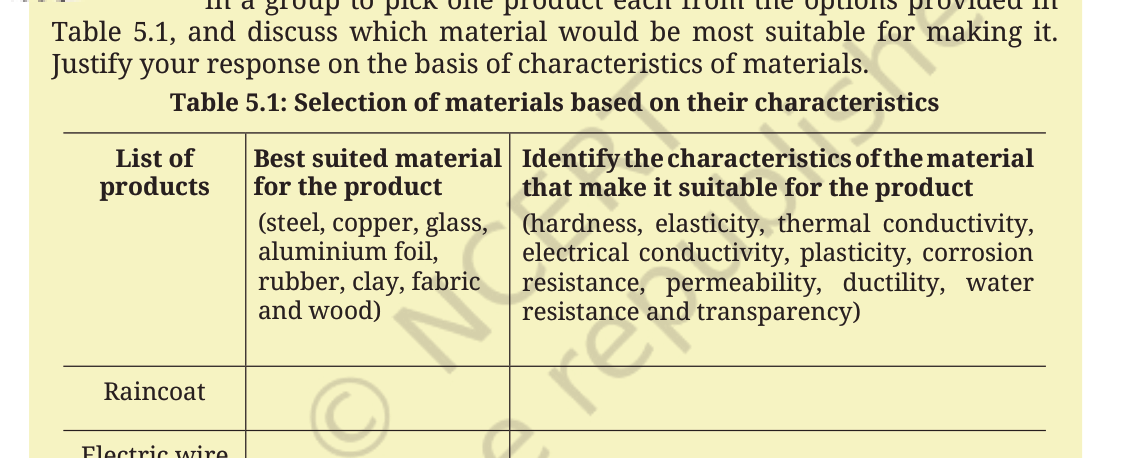
Table 5.1: Select the best-suited material for each product and identify the characteristic that makes it suitable.
Ans.
• Raincoat — Rubber/PVC-coated fabric — Water resistance – repels water and keeps the wearer dry
• Electric wire — Copper (core) with rubber/PVC cover — Electrical conductivity of copper; the covering is a non-conductive, flexible insulator
• Water bottle — Plastic — Light weight, water resistance and plasticity (can be moulded into shape)
• Cooking pot — Steel/aluminium — High thermal conductivity and ability to withstand high heat safely
• Cushion — Fabric (with soft filling) — Elasticity and flexibility, giving comfort and softness
• Window — Glass — Transparency – allows light to pass while sealing out weather
• Keychain — Metal/wood — Hardness and durability for daily rough use
• School bell — Metal (brass/steel) — Hardness and elasticity that let it vibrate and produce a clear, resonant sound