
Class 9 · Social ScienceNCERT 2026 Revised Syllabus
Chapter 3: Resistance and Resilience (1000–1700 CE) (0908CH03)
IN-TEXT QUESTIONS AND ACTIVITIES — Chapter 3 (Textbook pp. 53–76) — 10 questions with step-by-step answers.
Jump to:
IN-TEXT QUESTIONS AND ACTIVITIES — Chapter 3 (Textbook pp. 53–76)(10 questions)
p. 47
Hard
Recall the invasions of Mahmūd of Ghaznī and Muhammad Ghūrī mentioned in the chapter. How did Indian rulers respond, and what impact did these invasions have?
- a.Recall the invasions of Mahmūd of Ghaznī and Muhammad Ghūrī mentioned in the chapter.
- b.Explain how Indian rulers responded to these invasions.
- c.Compare the aims or outcomes of the two invasions, as discussed in the textbook.
Ans.
Mahmūd of Ghaznī began his invasions of the north-western Indian subcontinent in the early 11th century, including his campaign against Jayapāla in 1001. Indian powers such as the Hindu Shāhis, Chandellas, Solankīs and Chauhāns opposed the invaders. In 1178, Queen Nāikī Devī of the Chaulukya kingdom defeated Muhammad Ghūrī at Kasahrada near Mount Abu. Ghūrī later won the Second Battle of Tarain in 1192 against Prithvīrāj Chauhān, helping establish Turkish political control in parts of northern India. Resistance continued in regions such as Gujarat, Malwa, Bundelkhand, Odisha, Assam and Rajputana. The textbook notes that these invasions and conquests seriously disrupted the political, social and religious fabric of the subcontinent; the extent and nature of change varied by region.
p. 53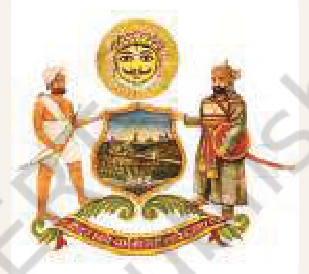
Explain the contribution of the Bhil community to Mahārāṇā Pratāp’s resistance, as recalled in the textbook.
- a.Explain the contribution of the Bhil community to Mahārāṇā Pratāp’s resistance, as recalled in the textbook.
Ans.
The Bhil community supported Mahārāṇā Pratāp through detailed knowledge of the Aravalli hills, forest routes and local terrain. They acted as guides, supplied tactical and logistical assistance, used archery and helped in guerrilla-style operations. Their alliance strengthened Mewar’s ability to resist a more powerful Mughal force. The textbook notes that the partnership was later represented in Mewar’s state emblem.
p. 54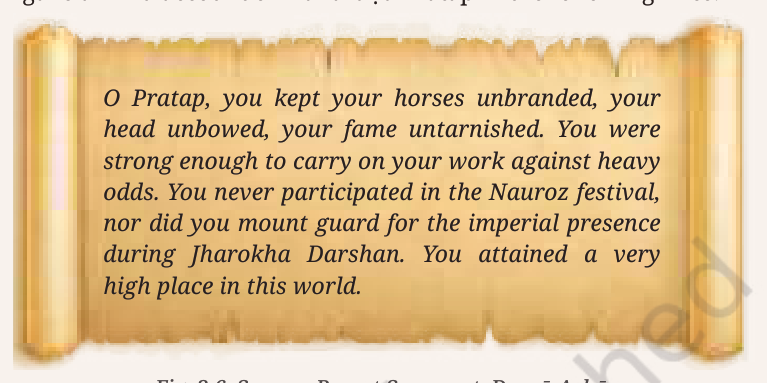
Identify any two actions in Dursā Arhā’s poem that show Mahārāṇā Pratāp maintained independence from the Mughal court.
- a.Identify any two actions described in Dursā Arhā’s poem.
- b.Explain how each action shows that Mahārāṇā Pratāp maintained independence from the Mughal court.
Ans.
Any two of the following are acceptable: (i) he kept his horses unbranded, avoiding a symbol of Mughal imperial control; (ii) he did not participate in the Nauroz festival; and (iii) he did not mount guard for the emperor during Jharokha Darshan. These actions are presented in the poem as signs that he did not accept the ceremonial subordination expected by the Mughal court.
p. 57
Recall the achievements of Vijayanagara under Kṛiṣhṇadevarāya. What happened to the empire after the Battle of Talikota in 1565?
- a.Recall the achievements of Vijayanagara under Kṛiṣhṇadevarāya.
- b.Explain what happened to the empire after the Battle of Talikota.
Ans.
Kṛiṣhṇadevarāya (r. 1509–1529) expanded and secured Vijayanagara’s dominance in the Deccan, won campaigns against neighbouring powers and supported temples, including Tirupati and the Vitthala temple at the capital. His reign is associated with military strength and cultural patronage. In 1565, an alliance of Deccan sultanates defeated the Vijayanagara army at the Battle of Talikota. The city was subsequently sacked and largely abandoned, and the empire gradually broke into smaller Nāyaka-ruled kingdoms.
p. 58
Recall the strategies and institutions that helped Chhatrapati Śhivājī and the Marathas establish and strengthen their power.
- a.Recall the strategies used by Chhatrapati Śhivājī and the Marathas to establish and strengthen their power.
- b.Identify the institutions that supported their administration.
Ans.
Model answer: Chhatrapati Śhivājī used the Deccan’s hills, forests and passes to conduct swift attacks and avoid unfavourable battles. A network of forts protected territory, supplies and routes. Mobile cavalry and guerrilla methods (often called ganimi kāva) helped challenge larger armies. The Marathas also developed naval capabilities along the coast and organised administration, including the council of ministers known as the Aṣṭapradhān. Local revenue arrangements and disciplined administration helped sustain the state. Use the exact institutions taught in the Grade 8 Part 1 chapter as the primary reference.
p. 64
Explore how the Nayanar saints Karaikal Ammaiyar and the Alvar saint Andal contributed to the spread of Bhakti in peninsular India.
- a.Explain how Karaikal Ammaiyar contributed to the spread of Bhakti.
- b.Explain how the Alvar saint Andal contributed to the spread of Bhakti in peninsular India.
Ans.
Karaikal Ammaiyar was an early Tamil Shaiva poet-saint whose hymns expressed intense personal devotion to Shiva and contributed to the Nayanar tradition. Andal, one of the Alvar saints, composed Tamil devotional works such as the Tiruppavai and Nachiyar Tirumoli, expressing love and surrender to Vishnu. Their poetry used the language of the people, connected devotion with everyday emotion and worship, and helped spread Bhakti beyond formal institutions. Their lives also show that women played an important role in devotional traditions.
p. 67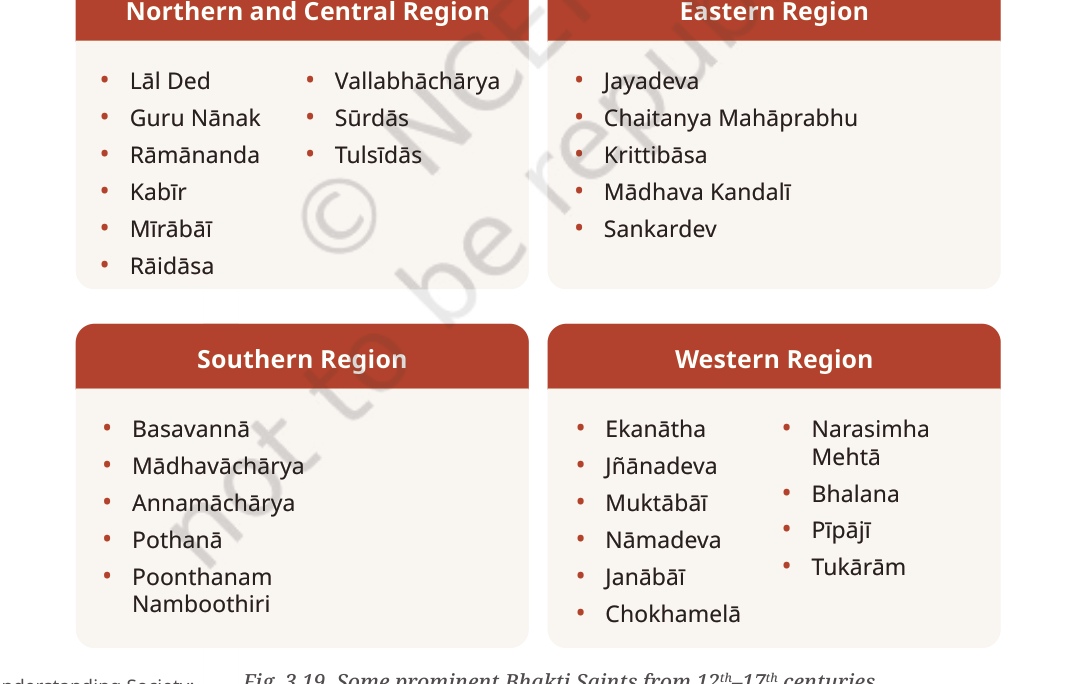
Locate the present-day states associated with the Bhakti saints shown in the infographic. Add a saint from your own State/UT and explain a song, poem or verse by one of the saints.
- a.Locate the present-day states associated with the Bhakti saints shown in the infographic.
- b.Add a Bhakti saint from your own State or region and briefly describe their contribution.
Ans.
Use the saint names and regions printed in the textbook infographic as the authority for the map. Examples for a short explanation include: Andal’s Tamil hymns express loving devotion to Vishnu; Kabir’s verses criticise empty ritual and stress inner devotion and ethical living; Lāl Ded’s vakhs encourage spiritual truth to be lived rather than merely memorised. Add a saint from your own State/UT only after checking a reliable regional source. Mark the relevant State/UT clearly and write two or three sentences explaining the chosen verse in your own words.
p. 67
Lāl Ded says it is easy to learn scriptures but hard to live them. What is the difference between knowing a rule and actually following it? Give an example from daily life.
- a.Explain the difference between knowing a rule or teaching and putting it into practice.
- b.Use Lāl Ded’s statement to show why lived values are more difficult and important than merely memorising scriptures.
Ans.
Knowing a rule is intellectual understanding, while following it requires discipline and action. For example, a student may know that littering harms the environment but still drop a wrapper; the student follows the rule only when they put waste in the correct bin and encourage others to do the same. The saying teaches that values become meaningful when they shape behaviour, not merely when they are memorised.
p. 74
Why was a hundi a safer and more convenient choice than physically transporting money over long distances?
- a.Explain why a hundi was safer than physically carrying money over long distances.
- b.Explain why it was more convenient for merchants and traders.
Ans.
A hundi allowed a trader to deposit or arrange money with a trusted banker or merchant in one place and receive payment through an associate elsewhere. It reduced the need to carry heavy quantities of coins, lowering the risk of theft, robbery and loss during travel. It made trade faster and supported long-distance commercial networks. Trust, reputation and enforceable commercial practices were still essential; hundis were not risk-free.
p. 76
Identify cultural and economic pillars in a community. How do they contribute to resilience when society faces invasions or external pressures?
- a.Identify cultural pillars in a community.
- b.Identify economic pillars in a community.
- c.Explain how these pillars help a society remain resilient during invasions or other crises.
Ans.
Cultural pillars include places of worship, festivals, languages, oral traditions, music, literature, customary practices and shared values. Economic pillars include farming, irrigation, artisans, merchants, markets, trade routes, credit networks and community-owned resources. They contribute to resilience by maintaining social unity, transmitting knowledge, providing food and income, preserving identity and enabling people to reorganise after disruption. Strong institutions and cooperation help communities adapt without losing their cultural continuity.