
Class 9 · Social ScienceNCERT 2026 Revised Syllabus
Chapter 4: Governance and Public Policy (0908CH04)
IN-TEXT QUESTIONS AND ACTIVITIES — Chapter 4 (Textbook pp. 81–102) — 15 questions with step-by-step answers.
Jump to:
IN-TEXT QUESTIONS AND ACTIVITIES — Chapter 4 (Textbook pp. 81–102)(15 questions)
p. 82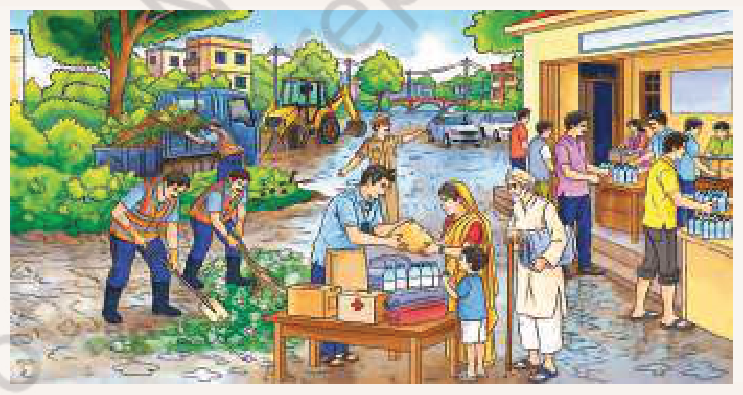
Discuss how the town should respond to several days of unusually heavy rainfall.
- a.Identify the people and organisations involved in responding to the heavy rainfall.
- b.Explain why a single department cannot solve the problem on its own.
- c.Describe what could happen if departments did not communicate or coordinate.
- d.Explain the role citizens can play before, during and after the rainfall.
- e.List the qualities that make the collective response effective.
Ans.
1. People and organisations: Municipal corporation, Public Works Department, police, schools, health workers, local elected representatives, disaster-management teams, NGOs and residents.
2. Why one department is insufficient: Flooding affects drainage, roads, transport, health, education, power and safety at the same time; each requires specialised staff and resources.
3. If departments do not coordinate: Drainage may remain blocked, ambulances may be delayed, schools may issue conflicting instructions and relief may not reach vulnerable people.
4. Citizen role: Before rainfall, clear household drains where safe and follow alerts; during it, avoid floodwater, help vulnerable neighbours and report hazards; afterwards, maintain hygiene, report damage and support clean-up.
5. Effective qualities: Clear communication, defined responsibilities, timely information, trained staff, accessible shelters, accountability and community participation.
p. 83–84
Using the street-lighting example, explain the difference between government and governance. Give other examples from everyday life.
- a.Using street lighting, explain the difference between government and governance.
- b.Give other examples from everyday life that illustrate the difference.
Ans.
A municipal corporation or panchayat is part of government and has the authority to provide street lights. Governance includes identifying dark spots with residents, budgeting, installing lights, maintaining them, receiving complaints about faults and checking whether streets become safer. Other examples include: a public school being run by education authorities while governance includes teacher attendance, parent feedback and monitoring learning; or a water department supplying water while governance includes testing quality, repairing leaks and responding to complaints.
p. 85
Find out more about the journey of the Sengol through historical pictures and explain its connection with governance.
- a.Find historical pictures or reliable sources about the journey of the Sengol.
- b.Explain its historical and cultural significance.
- c.Explain its connection with rulership and good governance.
Ans.
Model response based on the textbook: The Sengol is a ceremonial sceptre associated with the Chola tradition and the idea that authority carries a duty to govern justly. The textbook states that it was presented to Jawaharlal Nehru by Adheenam saints around Independence in August 1947 and was placed in the newly inaugurated Parliament building in 2023. For the visual project, arrange dated photographs and captions in chronological order and explain the values of responsibility, justice and public welfare associated with the symbol. Distinguish the textbook’s account from any additional historical interpretation you may find.
p. 86
Recall the Sabhā and Samiti mentioned in the Ṛigveda. What role did these institutions play in matters of governance and public welfare?
- a.Recall the Sabhā and Samiti mentioned in the Ṛigveda.
- b.Explain their role in governance and public welfare.
Ans.
The Ṛigveda refers to the Sabhā and Samiti as important assemblies associated with collective discussion in the Vedic period. They provided settings in which matters of governance and public welfare could be considered. Their reference shows that consultation and deliberation had a place in early Indian political traditions. They should not be described as identical to modern elected legislatures, because their composition, powers and social context were different.
p. 87
Select two Indian cities recognised for cleanliness and prepare a visual presentation explaining their good-governance models.
- a.Select two Indian cities recognised for cleanliness.
- b.Explain the good-governance models used by each city.
- c.Show how local government, citizens and other organisations contribute.
Ans.
Use two cities and state the Swachh Survekshan edition or award year being discussed, because rankings change by year. Indore and Surat can be used as illustrative case studies if they match the selected edition. For each city, explain: (i) door-to-door waste collection; (ii) segregation at source; (iii) processing or composting of wet waste; (iv) recycling and responsible disposal of dry waste; (v) public toilets and street cleaning; (vi) citizen complaints and monitoring; and (vii) participation by market associations, resident groups, schools and NGOs. Add photographs, a comparison table and sources.
p. 88
Choose a State or Union Territory and prepare a short paper on good-governance initiatives and suggestions for improvement.
- a.Choose one State or Union Territory.
- b.Describe its good-governance initiatives.
- c.Suggest practical improvements to strengthen service delivery and accountability.
Ans.
Model structure: (1) Name the State/UT and introduce its governance priorities. (2) Describe two or three initiatives, such as online certificates, land-record services, public grievance portals, digital payments, health or education services, and local-government programmes. (3) Explain who implements them and how citizens access them. (4) Identify gaps such as poor connectivity, language barriers, delays or lack of awareness. (5) Suggest help desks, accessible language, public dashboards, timely grievance disposal and regular social audits. Replace the examples with verified initiatives from the State/UT chosen by your group.
p. 88
Why is 25 December observed as National Good Governance Day, and how is it celebrated in your district?
- a.Explain why 25 December is observed as National Good Governance Day.
- b.Find out and report how it is celebrated in your district.
Ans.
National Good Governance Day is observed on 25 December because it is the birth anniversary of former Prime Minister Atal Bihari Vajpayee. The day is used to highlight transparent, accountable and citizen-centred administration. Activities may include seminars, public-service camps, awareness drives, grievance-redressal reviews, discussions and pledges. District-level programmes vary, so confirm the actual activities from the district administration’s notice or official website before writing about your own district.
p. 89
Complete the e-governance chart by stating the objective of each initiative and add two initiatives of your State Government.
- a.State the objective of UMANG.
- b.State the objective of Aadhaar.
- c.State the objective of GeM.
- d.State the objective of DigiLocker.
- e.State the objective of CPGRAMS.
- f.State the objective of APAAR.
- g.Add two e-governance initiatives undertaken by your State Government.
Ans.
For two State initiatives, add the State e-District/service portal and the State land-records or public-grievance portal, using their official names and URLs.
| Initiative | Main objective |
|---|---|
| UMANG | A unified platform to access many Central and participating State government services |
| Aadhaar | A unique identity number used for identity verification and authentication where legally permitted |
| GeM | An online marketplace for transparent procurement of goods and services by government buyers |
| DigiLocker | Secure digital storage and sharing of authentic documents and certificates |
| CPGRAMS | Centralised online system for submitting and tracking public grievances |
| APAAR | A unique student identity/academic account intended to help organise and access academic records |
p. 90
Interview people about six services and compare their experience before and after e-governance.
- a.Interview seniors, teachers, security guards, administrative staff and parents.
- b.Ask about obtaining a birth certificate.
- c.Ask about obtaining an admit card.
- d.Ask about collecting and storing marksheets.
- e.Ask about receiving salary.
- f.Ask about booking rail or flight tickets.
- g.Ask about registering a vehicle.
- h.Find out whether each person had internet and a smartphone or computer.
- i.Compare the problems experienced before e-governance with the experience after its introduction.
Ans.
Prepare a table for birth certificates, admit cards, marksheets, salary receipt, rail/flight tickets and vehicle registration. Ask each person how the service was obtained earlier, how long it took, how many visits or documents were needed, and how it works now. Common findings: earlier services often required paper forms, queues and repeated visits; digital platforms can allow online applications, status tracking, downloads and cashless payment. However, poor connectivity, lack of devices, language barriers, technical errors and cyber-fraud risks can still exclude users. Record actual interview responses rather than assuming everyone had the same experience.
p. 92–93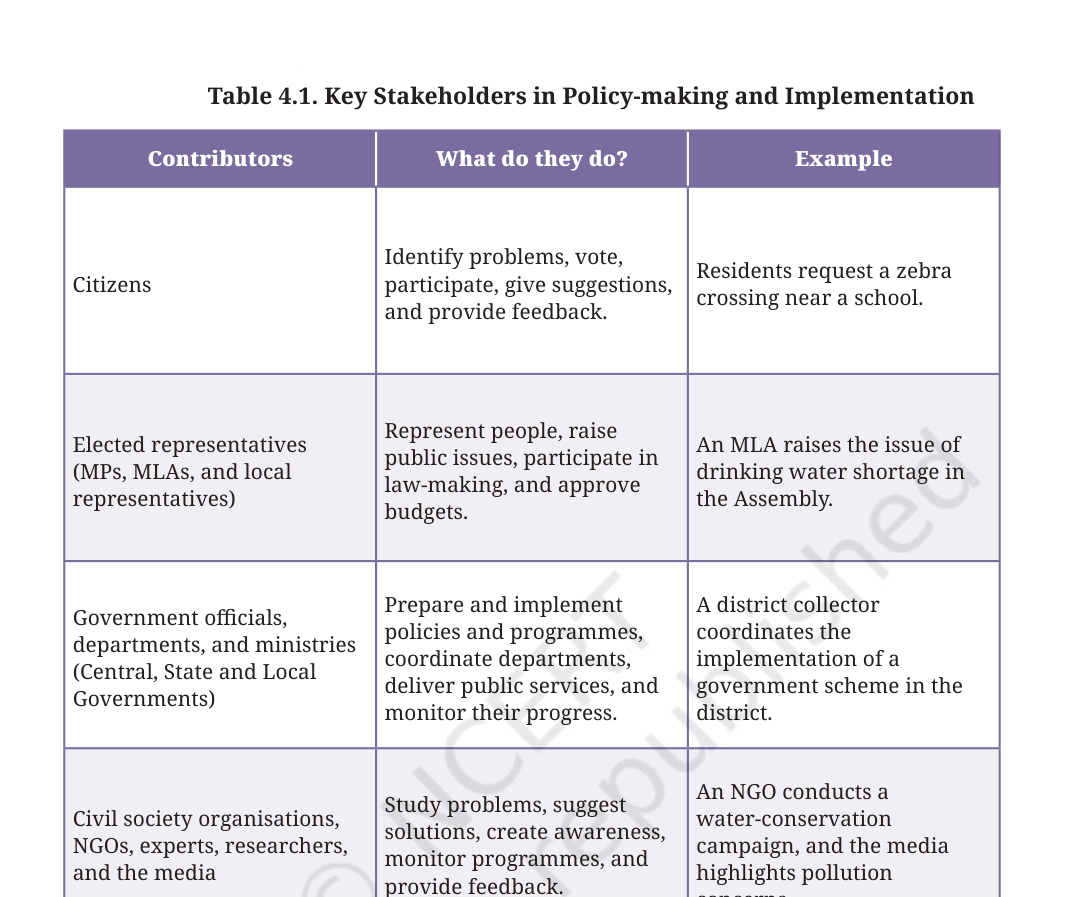
Classify each example as a policy or a public policy and give a reason.
- a.Classify the government sports policy example.
- b.Classify the safe-drinking-water campaign.
- c.Classify the company work-from-home rule.
- d.Classify the municipal waste-segregation initiative.
- e.Classify the housing-society visitor rule.
- f.Classify the government child-vaccination programme.
- g.Give a reason for each classification.
Ans.
| Example | Classification | Reason |
|---|---|---|
| Government introduces a sports policy | Public policy | Government action for a public sector and wider population |
| Government campaign for safe drinking water for every household | Public policy | Addresses a society-wide public-health need |
| Company permits work from home twice a week | Organisational policy | Applies to employees of that company |
| Municipality introduces city waste segregation | Public policy | Addresses a public sanitation and environmental issue |
| Housing society fixes guest visiting hours | Organisational/community policy | Applies to a limited residential group |
| Government provides free vaccination for children | Public policy | Protects public health across the community |
p. 95–96
Your school’s main gate faces a road that connects residential areas and a major market area. There is heavy traffic congestion on the road, especially during morning and afternoon hours. Pedal rickshaws, electric rickshaws, school buses, private vehicles, and pedestrians—all struggle to get their way. Form groups in your class and choose a course of action from the options given below: (1) Form a group of volunteers to regulate traffic in rush hours. (2) Write an application to the principal about the issue. (3) Meet the principal, along with all the class representatives of the school, to discuss the gravity of the situation and then impress upon the principal the need to take up the issue with the local people’s representative so that a traffic signal can be installed. (4) Request the school management to construct and open another gate on the other side of the school. (5) Suggest that the school shift its pick-up and drop-off point to a location slightly away from the main gate. (6) Change school timings so that the school’s opening and closing hours do not coincide with the busiest traffic hours in the market. Answer the follow-up questions about your choice, a better solution, stakeholders and a feedback loop.
- a.Which option did you choose and why?
- b.Can you suggest a better solution to address the problem? Compare your suggestion with the other options.
- c.Which stakeholders would be involved in solving the problem through your suggested solution? Explain their roles.
- d.Suggest a feedback loop to ensure that the problem does not recur.
Ans.
1. Choice and reason: I would choose option 3: class representatives and the principal should document the problem and raise it with the local people’s representative and traffic authorities. This is safer and more likely to produce a lasting, lawful solution than asking students to regulate moving traffic themselves.2. Better combined solution: Conduct a short traffic survey during arrival and dispersal; designate a pick-up/drop-off point away from the gate; stagger dispersal times where feasible; provide a safe pedestrian crossing and clear signs; prevent vehicles from stopping across the gate; and request traffic-police support at peak times. Compare the options: a written application creates a record but may be slow on its own; another gate may be costly and require approval; shifting the pick-up point and staggered timings can reduce congestion more quickly; and a signal may help only if traffic engineers find it suitable. A combination should be selected after a site assessment.3. Stakeholders and roles: The principal and school management coordinate school timings and pick-up arrangements; teachers and class representatives communicate the plan; parents and school-bus operators follow designated routes and timings; traffic police manage traffic and pedestrian safety; the municipal/local authority assesses road markings, crossings, signs and any signal; local residents and market associations share concerns and avoid obstructing the road. Students may share feedback only under adult supervision and must never be placed in the roadway to direct vehicles.4. Feedback loop: Record traffic queues, unsafe crossings, blocked gates and near-misses before the change. Collect feedback from parents, residents, drivers, students and traffic police after implementation. Review the information weekly for the first month, identify what is not working, adjust timings or pick-up arrangements, communicate revisions, and measure the same indicators again. Continue periodic checks so that new problems are detected early.
p. 96–97
Hard
Read the “A Ramp to Better Healthcare” case study and answer the questions about the policy stages, stakeholders and accessibility improvements for another public building.
- a.Arrange the stages of the policy process in sequence for upgrading the hospital.
- b.Identify at least three stakeholders involved in solving the problem.
- c.Identify a public building in your locality that could be made more accessible.
- d.Suggest suitable accessibility improvements for that building.
Ans.
1. Stages in sequence: identify the access problem; consult patients, staff, disability groups and experts; prepare the accessibility plan; obtain government approval and funding; construct the improvements; monitor their use; collect feedback and evaluate whether access has improved.
2. Stakeholders: patients and families, hospital management, Health Department, PWD, district administration, architects, disability-rights organisations, senior citizens and local representatives.
3. Local building improvements: a school, bus station, public office or library may need ramps, lifts, handrails, tactile paths, Braille and high-contrast signs, accessible toilets, reserved parking and clear routes. Ask users with different needs to review the design.
p. 99
In a role-play on the National Education Policy (NEP) 2020, explain how each stakeholder can contribute to its successful implementation.
- a.Explain the contribution of the Union and State Governments.
- b.Explain the contribution of school leaders and teachers.
- c.Explain the contribution of parents and students.
- d.Explain how NGOs, communities and the media can support implementation of NEP 2020.
Ans.
The Union Government sets the national framework, provides guidance and coordinates with States. State governments adapt and implement the policy, allocate resources and monitor schools. Principals prepare school plans and support teachers. Teachers use appropriate pedagogy and assessment. Parents encourage attendance and communicate students’ needs. Students participate actively and provide feedback. NGOs may support inclusion, teacher training and community outreach; journalists can report progress and gaps accurately. Effective implementation requires cooperation rather than the responsibility of one stakeholder alone.
p. 99
What would be the implications if any step in policy-making or implementation were skipped? Give a suitable example.
- a.Explain the consequences of skipping a stage in policy-making or implementation.
- b.Give a suitable example showing how the omission could affect the policy’s success.
Ans.
If consultation is skipped, the policy may ignore the needs of affected communities. If evidence and feasibility checks are skipped, the plan may be unrealistic. If adoption or legal approval is bypassed, implementation may lack authority. If departments are not coordinated or resources are not provided, the programme may fail. If monitoring and evaluation are skipped, problems may continue unnoticed. For example, planting one lakh trees without selecting suitable native species, watering them or monitoring survival can result in very few trees surviving.
p. 102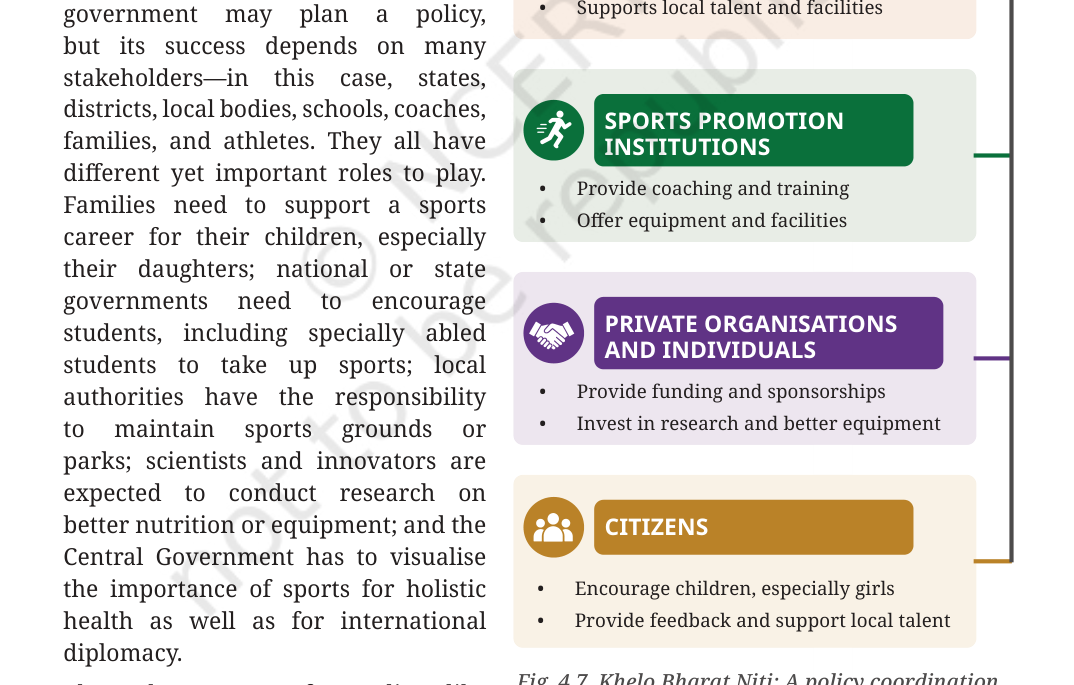
Answer the following questions about Khelo Bharat Niti 2025.
- a.Explain how students can contribute to Khelo Bharat Niti 2025.
- b.Suggest how your school can act as a sports ambassador.
- c.Identify the ministries that should work together and explain their roles.
Ans.
1. Student role: Take part in sports, encourage classmates (including girls and students with disabilities), follow fair play, volunteer in supervised events and provide suggestions for improving facilities.
2. School as sports ambassador: Prepare an inclusive sports calendar, identify student talent, provide safe facilities and equipment, train teachers/coaches, organise inter-house and community events, maintain fitness and safety standards, and connect with local sports bodies.
3. Ministries: The Ministry of Youth Affairs and Sports has the lead role. The Ministry of Education and State education departments support school sports; the Ministry of Health and Family Welfare can support fitness and health awareness; and other departments may help with infrastructure, inclusion and community participation. Coordination is needed across levels.