
Class 9 · Social ScienceNCERT 2026 Revised Syllabus
Chapter 5: Managing Your Personal Finances (0908CH05)
IN-TEXT QUESTIONS AND ACTIVITIES — Chapter 5 (Textbook pp. 107–120) — 11 questions with step-by-step answers.
Jump to:
IN-TEXT QUESTIONS AND ACTIVITIES — Chapter 5 (Textbook pp. 107–120)(11 questions)
p. 107
Reflect on how you use pocket money or money received during festivals and special occasions.
- a.Reflect on how you use pocket money or money received during festivals and special occasions.
- b.Explain whether you spend or save it immediately.
- c.Describe where you keep savings, such as a piggybank or another safe option.
- d.Explain how you manage daily expenses and plan a saving goal.
Ans.
Model response: I divide the money into three parts: essential or planned spending, savings for a future goal and a small amount for optional treats. I keep savings in a safe place with the help of a parent or guardian and record what I spend. For travel, stationery and canteen purchases, I estimate the cost beforehand and avoid spending the entire amount immediately. The exact amounts should reflect the student’s real circumstances.
p. 108
Have you thought about earning your own money? What skills would you need and what work would you choose?
- a.Consider whether you have thought about earning your own money.
- b.Identify the skills you would need.
- c.Suggest suitable work you could choose, keeping your age, safety and school responsibilities in mind.
Ans.
Model response: A student could develop skills such as explaining school subjects, designing simple posters, basic coding, craft-making or helping with a supervised family/community project. The most important requirements are honesty, punctuality, communication, problem-solving and safe use of technology. Any paid activity by a young person must follow applicable child-protection and labour laws and be approved by a parent or guardian; education and safety must come first.
p. 109
Set a financial goal by answering the four questions given in the textbook.
- a.What do I want to achieve?
- b.How much money will I need?
- c.By when do I want to achieve this goal?
- d.What steps can help me reach this goal?
Ans.
Model goal: I want to buy a badminton racket costing ₹1,200. I need ₹1,200 and would like to buy it in six months. I will save ₹200 each month, compare prices before buying and avoid unnecessary spending. The goal is specific, measurable and time-bound. Replace the product, amount and deadline with your own realistic goal.
p. 109
You and your friends need new badminton rackets for a tournament. How would you manage the budget?
- a.Estimate the total cost of the badminton rackets needed for the tournament.
- b.Explain how you would manage the budget.
- c.Suggest expenses that could be reduced and state whether borrowing would be appropriate.
Ans.
First find the number of rackets required and compare prices and quality at different shops. Calculate the total cost, including any necessary accessories. Decide how much each person can contribute and whether existing savings are sufficient. If the amount is too high, choose a durable lower-cost option or postpone non-essential purchases. Borrowing should be considered only with parental guidance and a clear repayment plan. Record the expenses so that the group does not exceed its budget.
p. 109
Prepare a weekly or monthly budget using the template referred to on page 122.
- a.Prepare a weekly or monthly budget using the template referred to on page 122.
- b.List the sources of income or money available during the chosen period.
- c.Classify expenses into needs and wants, and distinguish fixed from variable expenses where appropriate.
- d.Set aside a realistic amount for savings and check that total planned expenses do not exceed available income.
Ans.
Model weekly budget (illustrative): money available ₹500; travel ₹150; stationery ₹80; meals/snacks ₹100; school activities ₹50; savings ₹100; other ₹20. Total = ₹500. A monthly budget should use actual amounts and include regular as well as occasional costs. If expenses exceed income, review wants first, compare prices and adjust the plan rather than using unplanned debt.
p. 111
Reflect on receiving ₹100, spending on needs or wants, saving first and whether low-income people can save.
- a.What would you do if you received ₹100 today? Would you save some or all of it, or spend it right away?
- b.Would you prefer spending the money on a want or a need?
- c.Do you agree with the suggestion to save first and spend what is left?
- d.Can individuals with low income also save? Why or why not?
Ans.
Model response: I would first consider whether I have an immediate need, then save a portion of the ₹100 and use the remainder for a necessary or planned purchase. Needs such as food, transport or school supplies should generally come before wants such as an extra treat. “Save first, spend later” encourages discipline, but the amount must be realistic after essential expenses. People with low incomes may save small amounts when possible, but they also need fair wages, affordable services and protection from emergencies; saving is not equally easy for everyone.
p. 112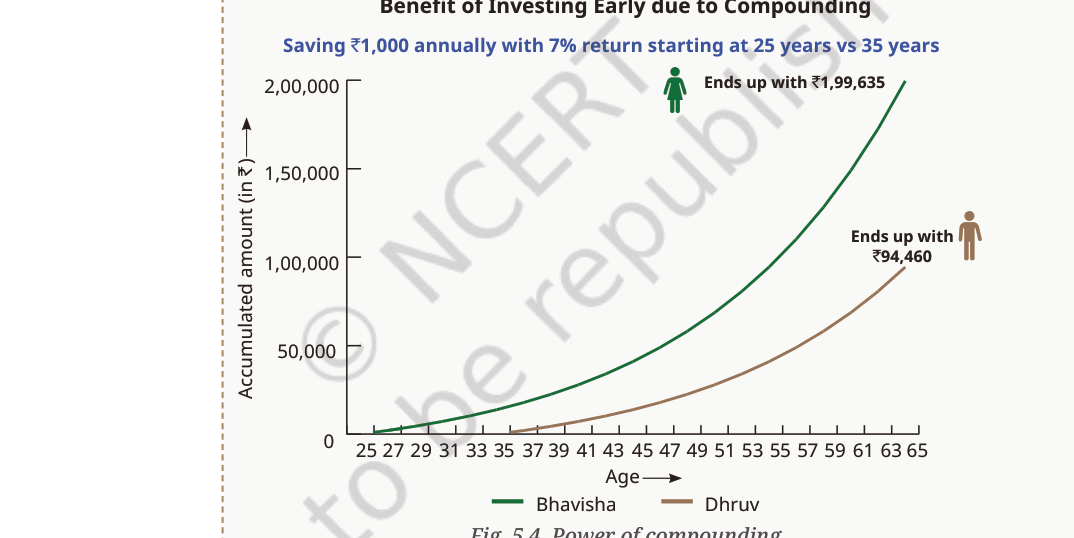
Why are the curves in Fig. 5.4 flatter at first and steeper in later years? Find the fixed-deposit rates offered by a bank.
- a.Explain why the curves in Fig. 5.4 are flatter in the early years and steeper later.
- b.Find fixed-deposit rates offered by a bank.
- c.Record the date, tenure and relevant customer category when comparing rates.
Ans.
At the beginning, the investment base is small, so the annual addition is modest. As returns are reinvested, future returns are earned on a larger balance, producing compound growth and a steeper curve. For the second task, compare current fixed-deposit rates from the official websites of two or more banks. Record the date checked, deposit period, general-customer rate and senior-citizen rate where applicable. Rates change, so do not treat an old textbook figure as a current offer.
p. 114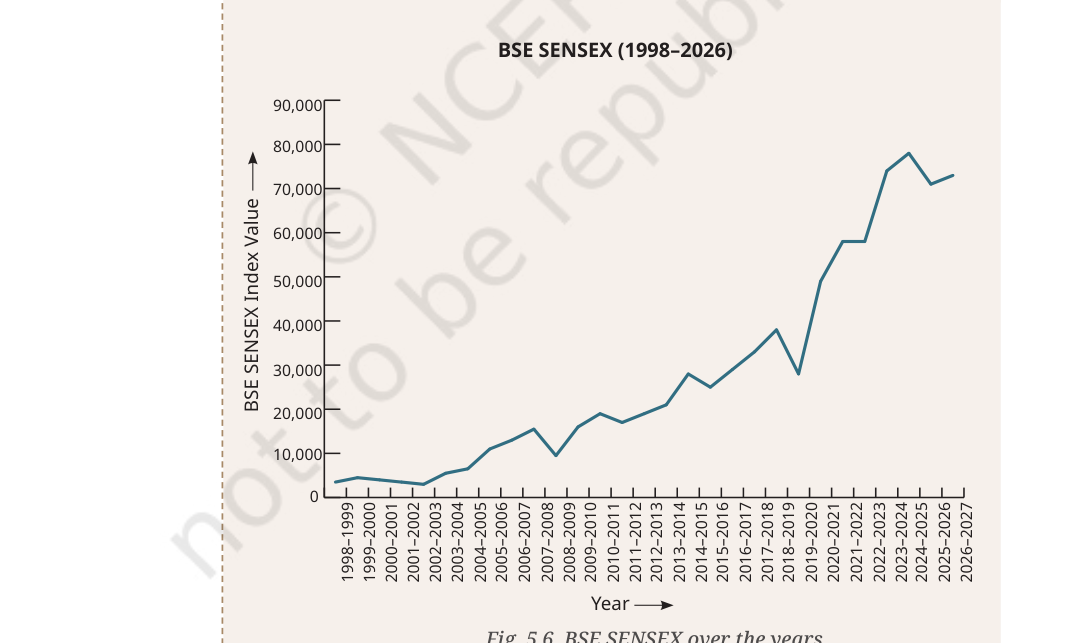
Why does the BSE SENSEX fluctuate over short periods even though the graph may rise over the long term?
- a.Explain why the BSE SENSEX fluctuates over short periods.
- b.Explain why the long-term graph may show a different overall trend.
Ans.
Share prices change as investors respond to information and expectations. Short-term fluctuations can be caused by company profits or losses, policy announcements, interest-rate changes, inflation, exchange rates, global crises, elections, natural disasters and changes in investor confidence. Over long periods, economic growth, business expansion and rising corporate earnings may contribute to an upward trend, but the market does not rise every year and past performance does not guarantee future returns.
p. 115
Why do mutual-fund advertisements include the warning that investments are subject to market risks?
- a.Explain why mutual-fund advertisements carry the warning that investments are subject to market risks.
- b.Describe what an investor should understand before investing.
Ans.
Mutual funds invest in market-linked assets such as shares and bonds. Their value may fall due to company performance, interest rates, economic conditions or market volatility, and investors can lose part of their money. The warning communicates that returns are not guaranteed and that investors should understand the scheme’s objective, risk level, asset mix, fees, time horizon and exit conditions before investing. Diversification can reduce some risks but cannot remove market risk.
p. 117
Why might a family buy something on EMI even if it costs more in the long run? Can too many EMIs affect savings and emergency funds?
- a.Explain why a family might choose to buy something on EMI even if the total cost is higher.
- b.Explain how too many EMIs can affect savings and emergency funds.
Ans.
A family may choose an EMI because it cannot or does not want to pay the full price at once, because the item is urgently needed, or because instalments fit its monthly cash flow. However, the total amount paid includes interest and possibly fees. Multiple EMIs can consume a large share of income, leaving less money for savings, essentials and emergencies. Before borrowing, compare the total repayment, interest rate, fees, loan duration and affordability.
p. 120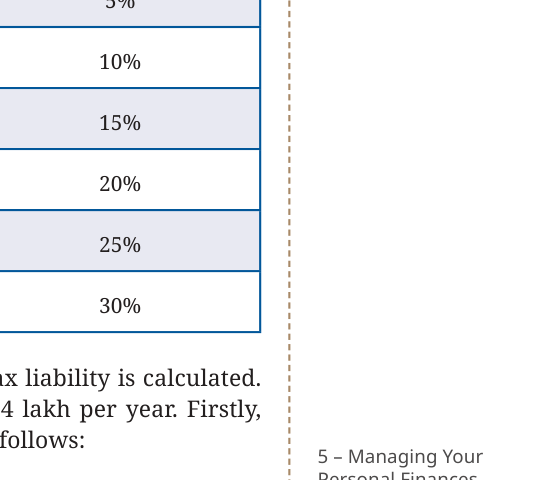
Sai’s taxable income is ₹3,80,000. How much income tax does Sai pay under the tax slabs shown in the textbook? Also prepare a short report on how to file an income-tax return.
- a.Calculate Sai’s income tax under the tax slabs shown in the textbook for taxable income of ₹3,80,000.
- b.Prepare the requested report on income tax and the Income Tax Return (ITR), using the textbook’s assumptions.
Ans.
Calculation using the textbook table: Sai’s taxable income = ₹3,80,000. The first slab is “up to ₹4,00,000” at 0%. Therefore, tax = ₹3,80,000 × 0% = ₹0 under the table printed in the textbook. This is a classroom calculation, not a statement about every filing obligation or a substitute for current tax rules.
Model report on filing an income-tax return: A taxpayer gathers PAN and income details, salary or interest statements, tax-deduction information and the relevant annual tax statement. They select the applicable assessment year and tax regime, calculate income and permitted deductions, complete the return on the official Income Tax e-Filing portal, check the entries, submit the return and complete e-verification. They save the acknowledgement and respond to any official notice. Current rules, forms, deadlines and filing requirements should be checked on the official portal or with a qualified tax professional.