
Class 9 · Social ScienceNCERT 2026 Revised Syllabus
Chapter 6: From Ideas to Startups (0908CH06)
IN-TEXT QUESTIONS AND ACTIVITIES — Chapter 6 (Textbook pp. 125–137) — 6 questions with step-by-step answers.
Jump to:
IN-TEXT QUESTIONS AND ACTIVITIES — Chapter 6 (Textbook pp. 125–137)(6 questions)
p. 125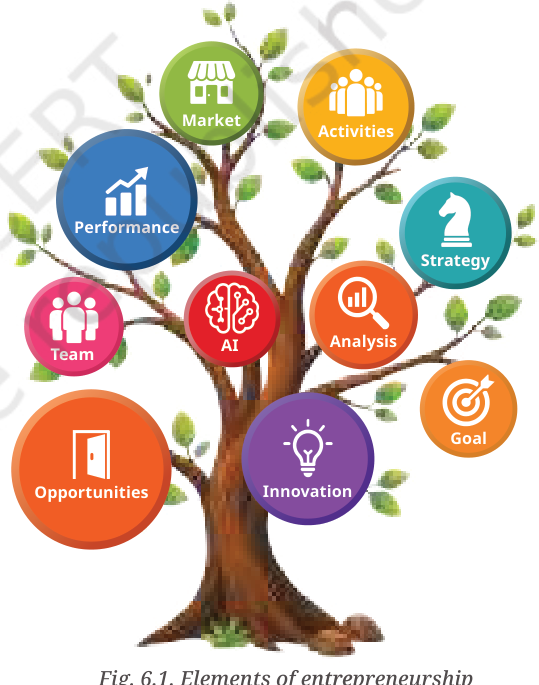
Imagine running a lemonade stall at the school festival. What would be required to run it successfully?
- a.Identify the product and customers for a lemonade stall at the school festival.
- b.List the materials, equipment, people and funds required.
- c.Explain how you would set the price, maintain hygiene and attract customers.
Ans.
A student team should estimate how many glasses may be sold, calculate the cost of lemons, sugar, water, ice and cups, and identify a safe and reliable supplier. It should arrange clean drinking water, hygienic preparation, suitable equipment, a clean serving area and proper waste disposal. The team should decide a fair selling price, assign roles, obtain school permission, record sales and expenses, and calculate profit or loss as revenue minus total costs. Any figures used should be labelled as estimates.
p. 127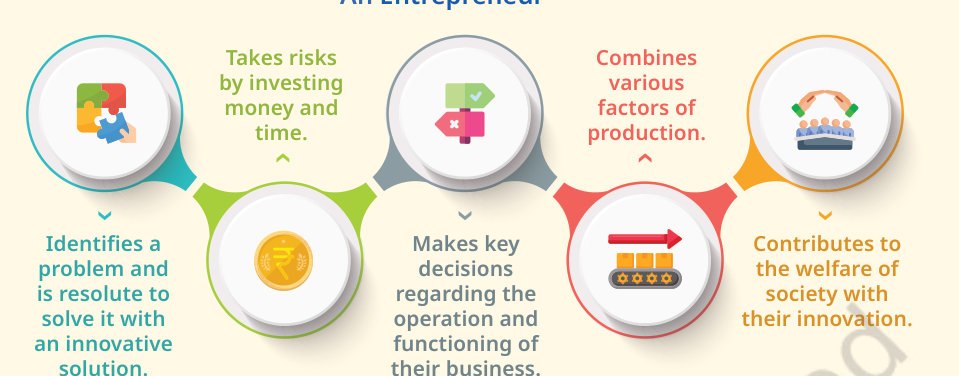
What can be learned from the Jataka story of the young man who turned a dead mouse into wealth? Is success about spotting opportunities or working smart? What traits do entrepreneurs need?
- a.Summarise the Jataka story of the young man who turned a dead mouse into wealth.
- b.Explain how he identified an opportunity and created value.
- c.Discuss whether success depends only on spotting opportunities or also on effort, planning and trust.
Ans.
The young man noticed a small opportunity, began with the limited resources available, exchanged goods strategically and reinvested his earnings. His progress depended both on spotting opportunities and working intelligently. Useful entrepreneurial traits include creativity, initiative, perseverance, problem-solving, market awareness, communication, adaptability, financial discipline, risk assessment and honesty. The story also shows social responsibility because he later shared his wealth with the community.
p. 128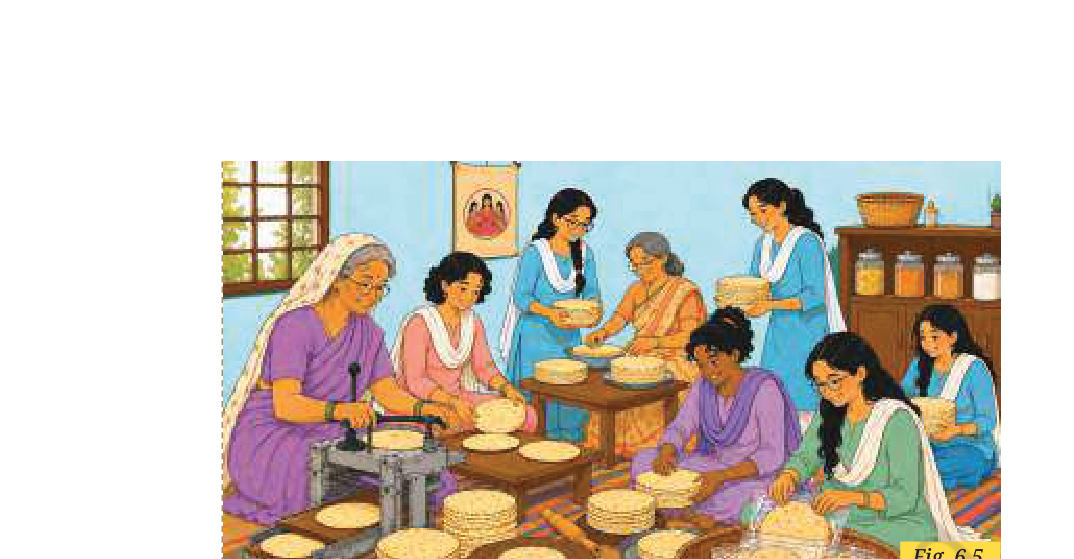
Think about the Lijjat Papad cooperative. What problem did it solve beyond selling papads? What challenges might its founders have faced, and what similar cooperative could be started in your community?
- a.Identify the problem that the Lijjat Papad cooperative solved beyond selling papads.
- b.Explain how collective work created income and opportunities for women.
- c.Discuss challenges the founders may have faced while building the cooperative.
Ans.
1. Problem beyond sales: It created a means for women to earn income, participate in a member-owned enterprise, share profits and gain economic independence and confidence.
2. Possible early challenges: limited starting capital, lack of machinery and premises, finding buyers, maintaining uniform quality, organising production across homes, transport and competition. The founders could respond through shared rules, cooperative ownership, consistent standards, pooled resources and reliable distribution.
3. Community idea: a women’s or youth cooperative that processes local grains, pickles, honey, millets, handicrafts or reusable cloth bags. Members should agree on quality, pricing, accounts, decision-making and fair sharing of income.
p. 130–132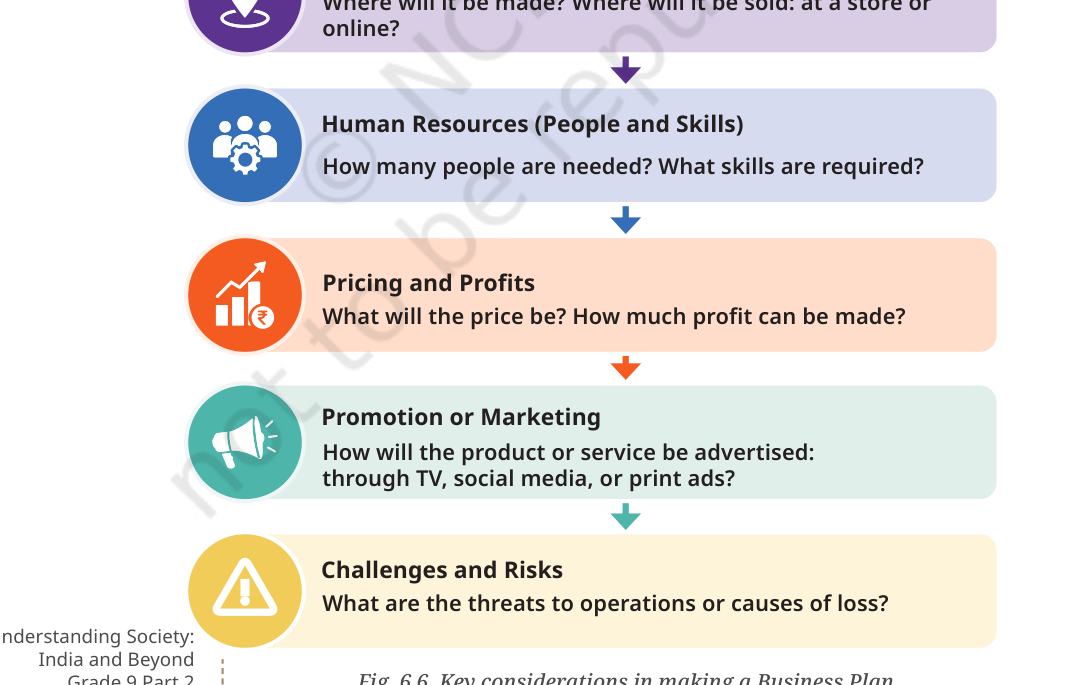
Hard
Use the bakery example to explain all the key questions that should be considered while preparing a business plan, including customer needs, target customers, finance, location, staff, pricing, promotion, packaging, customer service, inventory, quality, demand and competition.
- a.What do customers need, which bakery products should be offered, and what will make the idea fresh, affordable or unique?
- b.Who are the potential customers, and should the bakery specialise in products for children, young adults, families or other groups?
- c.How much start-up money is required, what expenses must be estimated, and where could the funds come from?
- d.Where should the bakery be located, and how could online orders or mobile apps expand its reach?
- e.How many employees are needed, and what skills and training should bakers, helpers, billing staff and delivery workers have?
- f.How can prices cover costs and generate profit while remaining affordable? Would different sizes or price options help?
- g.How should the bakery promote its products, choose suitable packaging, protect shelf life and improve customer service?
- h.How can perishable inventory be managed and consistent product quality maintained?
- i.How should the business respond to changing customer demand, rising costs and competition from other bakeries?
Ans.
Model bakery plan1. Needs and idea: Survey local people to learn whether they prefer fresh bread, cakes, pastries, whole-wheat products or healthier snacks. Offer products that meet a real need and have a clear difference, such as fresh, hygienic, affordable or locally distinctive goods.
2. Potential customers: Identify likely customers—families, school or college students, young adults, nearby offices and older people. Choose the product range according to their preferences rather than trying to serve everyone in the same way.
3. Money and costs: Estimate the cost of an oven, mixer, utensils, rent, electricity, ingredients, packaging, salaries, transport, licences and working capital. Arrange funds through the owners’ savings or suitable loans or investment, after comparing the terms and repayment burden.
4. Location and sales channels: Choose a hygienic, accessible location with suitable rent and customer footfall, such as near a market, school or residential area. Online ordering and mobile apps may extend the customer base, provided delivery can maintain product quality.
5. Human resources: Decide how many trained bakers, helpers, billing staff and delivery workers are needed. Assign clear duties and train employees in hygiene, food handling, customer service and equipment safety.
6. Pricing and profits: Calculate the cost per product, add a reasonable margin and compare prices with customers’ ability to pay. Different sizes or options, such as smaller cake jars, can provide affordable choices without selling below cost.
7. Promotion, packaging and service: Use a clear business name, signs, posters, social media, samples and suitable offers. Packaging should be food-safe, clean, protective and appropriate for the product so that freshness and shelf life are maintained. Take orders accurately, respond politely to complaints and provide reliable service to encourage repeat customers.
8. Inventory and quality: Forecast demand, purchase perishable ingredients in suitable quantities, store them at safe temperatures and use stock before it spoils. Follow standard recipes, hygiene checks and quality-control procedures so that products remain consistent.
9. Challenges and risks: Plan for competition, changing customer preferences, seasonal demand, rising ingredient prices, equipment failure and food wastage. Use customer feedback, backup suppliers, maintenance, careful cash-flow records and a flexible product mix to respond.A sound business plan links all these decisions. It should be reviewed when costs, demand, customer preferences or business conditions change.
p. 136
Interview two people in your vicinity who run a business and prepare a short report about their journey. Also prepare a report on the tasks an entrepreneur performs at each stage. Using the case study of Mohan Singh Oberoi, identify the functional area that helped improve the quality of the company’s services and explain how the functional areas worked together. Finally, create a business plan for your own idea using the template on pages 142–144.
- a.Ask each business owner why they started the business, what challenges they faced, what risks they took and what they learned.
- b.Prepare a short report on the tasks an entrepreneur performs at each stage, referring to Fig. 6.2.
- c.In the Mohan Singh Oberoi case, identify the functional area most directly responsible for maintaining service quality and explain how the other functional areas supported success.
- d.Create a business plan for your own idea using the template on pages 142–144: idea, entrepreneur profile, target customers, market research, product/service, resources, operations, marketing, finance, risks, social/environmental impact and conclusion.
Ans.
1. Interview report: Interview two nearby business owners, such as a shopkeeper, tailor or factory owner. Ask why each person started the business, what challenges they faced, what risks they took and what they learned. Add the business type, approximate starting resources, customers and main products or services. Obtain permission before recording or taking photographs.2. Tasks performed by an entrepreneur: (i) identify a need or opportunity; (ii) develop and test an idea; (iii) prepare a business plan; (iv) arrange finance, people, materials and technology; (v) start operations and take calculated risks; (vi) lead employees and coordinate functional areas; (vii) market the product and serve customers; and (viii) monitor results, solve problems and improve the business.3. Mohan Singh Oberoi case: The functional area most directly responsible for maintaining the quality and efficiency of hotel services is operations and management. It ensures that rooms, facilities and service processes meet required standards. Human resources recruits and trains staff; finance and accounting manages investment, costs and expansion; marketing and sales builds the brand and attracts guests; and customer-service practices keep guest satisfaction central. These areas coordinate, so the success of the hotel business cannot be credited to only one department.4. Model business plan — CycleCare Bicycle Servicea. Business idea: CycleCare; a small, appointment-based bicycle repair and maintenance service. Tagline: “Safe rides, reliable repairs.”
b. Entrepreneur profile: A student team with an adult mentor and a trained bicycle mechanic. The idea addresses the difficulty of finding convenient, fairly priced bicycle repairs.
c. Target customers: Students, parents, local residents and people who use bicycles for commuting.
d. Market research: Interview cyclists and compare nearby repair shops, prices, waiting times and common repair needs. The service would differentiate itself through transparent estimates, convenient appointments and basic maintenance reminders.
e. Product/service: Puncture repair, brake and chain checks, tyre inflation, cleaning and routine servicing. Safety-critical work is performed or checked by a trained adult mechanic.
f. Resources: A trained mechanic, supervised student support, repair stand, spanners, tyre levers, pump, patch kits, spare tubes, cleaning materials, a small workspace and start-up funds.
g. Operations: Receive the bicycle and describe the issue → inspect it → explain the fault and estimate → obtain the customer’s approval → complete the repair → test safety → provide a receipt and maintenance advice → collect feedback.
h. Marketing: Use permission-based posters, local community groups, word of mouth and tie-ups with schools or residential associations.
i. Illustrative monthly finance: Start-up finance from the owners’ contribution; estimated monthly rent and utilities ₹2,000, consumables and spare parts ₹3,000, transport and printing ₹500, and other costs ₹500. Total estimated cost = ₹6,000. If 60 services earn an average of ₹150, expected revenue = ₹9,000 and estimated surplus = ₹3,000. These are sample figures and must be replaced with local quotes.
j. Risks and challenges: Competition, shortage of spare parts, incorrect repairs, seasonal demand and customer safety. Mitigate them through trained work, quality checks, safe storage, clear estimates and responsible records.
k. Social and environmental impact: Affordable repair can improve access to mobility, extend the life of bicycles and reduce waste.
l. Conclusion: CycleCare can succeed if it is trusted, safe, fairly priced and responsive to local customers. The plan should be revised after collecting feedback and checking actual costs.
p. 137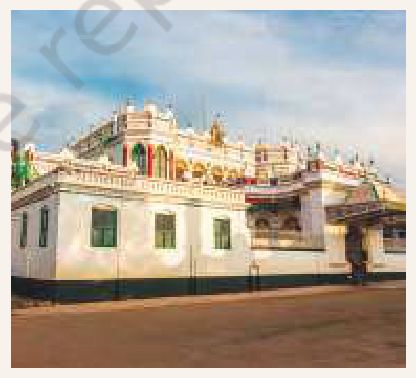
Find out about other regional communities in India that have excelled as entrepreneurs.
- a.Find examples of regional communities in India that have excelled as entrepreneurs.
- b.Research their historical occupations, skills, networks or institutions using reliable sources.
- c.Avoid stereotypes and explain that individuals within any community have diverse occupations and abilities.
Ans.
A short research note may compare two communities using reliable historical or regional sources. For example, the textbook describes Chettiars as traders, bankers and moneylenders with strong accounting and record-keeping traditions and business links across South and South-East Asia. Research may also examine particular Marwari, Gujarati, Sindhi or Bohra business networks. Explain the region, historical occupations, products or services, trade routes, financial practices and community institutions. Avoid assuming that every member of a community has the same occupation or business ability.