
Class 9 · MathsNCERT 2026 Revised Syllabus
Chapter 13: Two Variables, One Line (0904CH13)
Think and Reflect — 17 questions with step-by-step notebook-style answers.
Jump to:
Think and Reflect(17 questions)
Page 88(1 question)
1
Are (1,
$\frac{9}{2}$), (0, 6), (4, 1) and ($\frac{1}{2}$, $\frac{21}{4}$) solutions of the equation 3x + 2y = 12?Can you find any other solution? How many solutions can you find?School Level Solution
Page 92(1 question)
2
Four friends — Ranju, Meena, Farhan, and Toshi — are solving problems.Ranju: I noticed something! If c = 0 in the standard form of a line ax + by + c = 0, then the line must pass through the origin. Look, if I substitute x = 0 and y = 0, in equation ax + by = 0, the equation is satisfied. So, the origin lies on the line! We can also say that the line passes through the origin.Farhan: Let us try for the equation 2x + 3y = 0. Here a = 2, b = 3 but c = 0. If we substitute x = 0, then we get 3y = 0 or y = 0. This means (0, 0) lies on the line. So yes, this line passes through the origin.Toshi: Suppose our equation has b = c = 0, say, 5x = 0. This becomes x = 0 which is the equation of the y-axis. And the y-axis passes through the origin.Meena: And if we take a = c = 0, say, 7y = 0, that means y = 0, which is the equation of the x-axis that also passes through the origin.So, they conclude: Whenever c = 0, the line ax + by + c = 0 will always pass through the origin, irrespective of the values of a or b. Do you agree with them?
School Level Solution
Page 97(1 question)
3
1. Consider the point on the line AB whose x-coordinate is 8. What is the y-coordinate of this point? Express this as an ordered pair.2. What is the x-coordinate of the point on the line AB whose y-coordinate is 6? Express this as an ordered pair.
School Level Solution
Page 99(1 question)
4
Can you use the points A, B and C to verify that the slope of this line is indeed −5?
School Level Solution
Page 104(1 question)
5
The cost of one paratha and 2 bowls of dahi is ₹90. Also, the cost of 2 parathas and 7 bowls of dahi is ₹260. Can you figure out the cost of one paratha and one bowl of dahi and explain your reasoning?
School Level Solution
Page 106(1 question)
6
Solve the puzzle and discuss your strategy with your friends. Can you determine the value represented by each shape?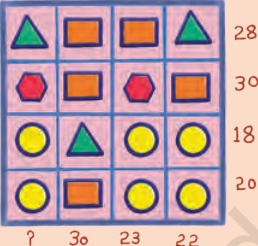
School Level Solution
Page 107(1 question)
7
What if we had expressed y in terms of x, i.e., take Equation (2) and write y =
$\frac{1}{2}$(3 − x). Would we still get the same solution?School Level Solution
Page 109(2 questions)
8
The method used in solving this problem is called the Elimination Method because we eliminate one of the variables to obtain a linear equation in the other variable. In the example above, we eliminated y. Try the same problem by eliminating x instead of y. Also try to solve the two equations using the Substitution Method. Assess the pros and cons of each method.
School Level Solution
9
Does a pair of linear equations always have a unique solution? Can you analyse this using the Elimination Method? While subtracting the equations to eliminate a particular variable, if the other variable remains, then clearly there is a unique solution. But what if the second variable gets eliminated too while eliminating the first variable? Can you think of a situation where this happens?
School Level Solution
Page 110(3 questions)
10
How many solutions are there to the equations10x − 5y = 20 and 4x − 2y = 8?Give 3 more examples of pairs of equations that lead to 0 = 0 after subtraction, and therefore have infinitely many solutions. Can you find a simple rule to check when this happens?
School Level Solution
11
What if one of a₂, b₂, c₂ is zero?
School Level Solution
12
Does a pair of linear equations always have either a unique solution or infinitely many solutions?
School Level Solution
Page 111(1 question)
13
Give 3 more examples of pairs of equations that have no solution. Can you find a simple rule to check when this will happen?
School Level Solution
Page 112(2 questions)
14
Are the converses of the above statements true?
School Level Solution
15
Can there be methods other than elimination and substitution to reduce a pair of linear equations in two variables to a linear equation in one variable? If so, describe them.
School Level Solution
Page 113(1 question)
16
How do we find solutions from the graph? What can we say about the number of solutions when the two lines (i) intersect at a point, (ii) are parallel, (iii) are coincident?
School Level Solution
Page 115(1 question)
17
Can you prove that two lines of equal slope are parallel?(Hint: Consider the equations of the two lines to be y = mx + d₁ and y = mx + d₂)
School Level Solution