
Class 9 · MathsNCERT 2026 Revised Syllabus
Chapter 12: Quadrilaterals (0904CH12)
End-of-Chapter Exercises — 24 questions with step-by-step notebook-style answers.
Jump to:
End-of-Chapter Exercises(24 questions)
1
Using a fact about parallelograms, show how to tile the plane using any given triangle. (Hint: Can you use the parallelogram tiling in the introduction?)
School Level Solution
2
Mark the midpoint of the line drawn on the paper (see Fig. 12.33), given that the horizontal lines are equally spaced. Justify your answer.
School Level Solution
3
You know that the sum of angles of a quadrilateral is 360°, even for a non-convex quadrilateral (Recall the proof.) Now consider a self-intersecting quadrilateral ABCD, where AB and CD intersect at point E. Show that ∠A + ∠B + ∠C + ∠D < 360°. Can you construct ABCD such that ∠A + ∠B + ∠C + ∠D = 2°?
School Level Solution
4
In a parallelogram ABCD, two points P and Q are taken on diagonal BD such that DP = BQ (see Fig. 12.34). Show that APCQ is a parallelogram.
School Level Solution
5
A right-triangle shaped cutout of a paper is folded such that point A touches point B (Fig. 12.35). Show that the crease line can be used to find the midpoint of not only AB but also that of AC.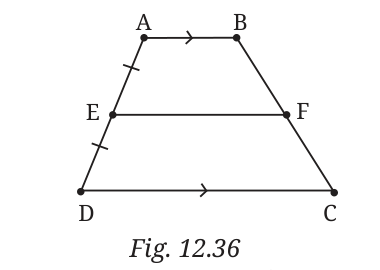
School Level Solution
6
You saw how to use the Midpoint Theorem to divide a given triangle into 4 congruent triangles. Can we divide a triangle into 3 congruent triangles? This exercise shows us how to do that and more, provided we are allowed to cut and reassemble.(i) Draw medians AP, BQ and CR of ΔABC, meeting in a common point M. Cut along each median to get 6 triangles. Show with justification how to assemble the 6 pieces into 3 congruent triangles! (Hint: Align ΔMPB and ΔMPC along equal sides PB and PC, matching P with itself and B with C.) Prove that you get a triangle. What are its side lengths?*(ii) Repeat the procedure with each of the 3 assembled triangles you got in (i). Show that each of the resulting 9 triangles has sides AB/3, BC/3 and AC/3.The procedure and the result above were unnoticed till 2014, when they were discovered by Lee Sallows, an amateur mathematician!(iii) Can we next ask about the possibility of cutting a triangle and reassembling it into 2 congruent triangles. You were asked this question in the chapter Measuring Space: Perimeter and Area. Can you solve this now? (Hint: Use median AP in ΔABC and then a median of ΔAPB.)For any two given figures with straight sides, we can ask whether one figure can be cut (using only straight cuts) into pieces and reassembled to make the other. This notion is called scissors congruence. The figures need not be in the plane. Research on such questions at a higher level is ongoing.
School Level Solution
$\dfrac{BC}{2}$, $\dfrac{CA}{2}$ and $\dfrac{AB}{2}$: this follows from the parallelograms formed by the half-turn construction and the midpoint relations. Reapplying part (i) makes the sides of each of its three pieces two-thirds of those medians, namely ($\dfrac{2}{3}$)($\dfrac{AB}{2}$)=$\dfrac{AB}{3}$, ($\dfrac{2}{3}$)($\dfrac{BC}{2}$)=$\dfrac{BC}{3}$ and ($\dfrac{2}{3}$)($\dfrac{AC}{2}$)=$\dfrac{AC}{3}$. Doing this for each of the three assembled triangles produces nine congruent triangles with those side lengths.(iii) First cut along median AP, producing △APB and △APC, with P the midpoint of BC. In △APB, let K be the midpoint of AB and draw median PK. Cut along PK. Rotate △PKB by 180° about K: B maps to A, and P maps to P′, with K the midpoint of PP′. The pieces △PKA and the rotated △PKB form △APP′ because P,K,P′ are collinear. Its sides are AP, AP′=BP=PC and PP′=2PK=AC (by the Midpoint Theorem in △ABC). Thus △APP′ and △APC have the same three side lengths AP, PC and AC, so they are congruent by SSS. This gives two congruent triangles after cutting and rearranging the three pieces.7
A more general midpoint theorem and its converse. In a quadrilateral ABCD, suppose AB ∥ DC. Recall that such ABCD is called a trapezium. Let E be the midpoint of AD. A line drawn through E intersects side BC at F.(i) If EF ∥ AB, then show that F is the midpoint of BC. Conclude that EF = (AB+CD)/2.(ii) If F is the midpoint of BC, then show that EF ∥ AB.There are at least two ways to solve (ii). Do it directly by using the midpoint M of BD and showing that EM and FM are the same lines. Or use (i) along with the same idea used in the second proof of the converse of the Midpoint Theorem. Which way do you think is simpler?
School Level Solution
$\dfrac{DC}{2}$. In △CAB, G is the midpoint of CA and GF∥AB, so F is the midpoint of CB and GF=$\dfrac{AB}{2}$. Hence EF=EG+GF=$\dfrac{DC}{2}$+$\dfrac{AB}{2}$=$\dfrac{AB+CD}{2}$.(ii) Let M be the midpoint of BD. In △DAB, E and M are the midpoints of DA and DB, so EM∥AB. In △DBC, M and F are the midpoints of DB and BC, so MF∥DC∥AB. Since EM and MF pass through M and are both parallel to AB, they are the same line. Therefore E,M,F are collinear and EF∥AB.8
The diagonals AC and BD of a parallelogram ABCD intersect at O. A line through O meets AB and CD at points P and Q respectively. Show that O is the midpoint of PQ. (Multiple proofs are possible. Which is the simplest?)
School Level Solution
9
ABCD is a trapezium with parallel sides AD = 3 cm and BC = 5 cm. E and F are the midpoints of the non-parallel sides. Find the ratio of the areas of the 4-gons AEFD and EBCF.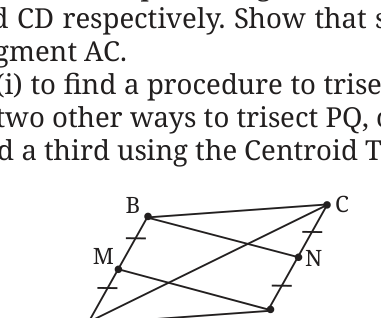
School Level Solution
$\dfrac{AD+BC}{2}$=$\dfrac{3+5}{2}$=4 cm. Let h be the distance between the two parallel sides. Since E and F are midpoints of the non-parallel sides, EF lies halfway between the bases, so each smaller trapezium has height $\dfrac{h}{2}$.Area(AEFD)=½(AD+EF)($\dfrac{h}{2}$)=½(3+4)($\dfrac{h}{2}$)=7$\dfrac{h}{4}$.
Area(EBCF)=½(EF+BC)($\dfrac{h}{2}$)=½(4+5)($\dfrac{h}{2}$)=9$\dfrac{h}{4}$.Therefore the ratio is (7$\dfrac{h}{4}$):(9$\dfrac{h}{4}$)=7:9.10
Consider 4 points A, B, C, D in the plane with no three collinear. Answer the following questions. Some answers may require you to consider different cases, depending on how the points are positioned in the plane.(i) How many different quadrilaterals do they form if the quadrilateral is allowed to be self-intersecting or non-convex?(ii) How many of these quadrilaterals are self-intersecting? How many are convex?
School Level Solution
$\dfrac{6}{2}$=3 (for example, ABCD, ABDC and ACBD).(ii) There are two configurations. If all four points are vertices of their convex hull, only the order around the outside is convex; the other two cyclic orders cross, so there is 1 convex and 2 self-intersecting quadrilaterals. If one point lies inside the triangle formed by the other three, each of the 3 orders gives a simple concave quadrilateral; none is convex or self-intersecting.11
Suppose P is a point on side AB of ΔABC and the line through P parallel to BC meets AC in point Q. For parts (i) to (iii), assume AP = 1, AQ = √5, and see Fig. 12.39.(i) If PB = 2 find QC. (Hint: See the dotted line)*(ii) If PB = 1/3 find QC. (Hint: See the dotted lines)*(iii) If PB = 2/3 find QC. (Hint: Divide both PB and AP suitably.)*(iv) Show that if AP/PB is a rational number, then AP/PB = AQ/QC. In Grade 10, you will prove this equality without assuming that AP/PB is rational. That will require a new idea.
School Level Solution
$\dfrac{1}{3}$ and AP=1, so AP:PB=3:1. Thus AQ:QC=3:1, and QC=$\dfrac{AQ}{3}$=$\dfrac{\sqrt{5}}{3}$.(iii) PB=$\dfrac{2}{3}$, so AP:PB=1:($\dfrac{2}{3}$)=3:2. Hence AQ:QC=3:2 and QC=($\dfrac{2}{3}$)AQ=$\dfrac{2\sqrt{5}}{3}$.(iv) Let $\dfrac{AP}{PB}$=$\dfrac{m}{n}$ for positive integers m,n. Divide AP into m equal parts and PB into n equal parts, all of common length. Through the division points draw lines parallel to BC. By repeated use of the midpoint/intercept result, the corresponding parts of AC are equal. The m parts comprising AQ therefore have the same unit length as each of the n parts comprising QC, so $\dfrac{AQ}{QC}$=$\dfrac{m}{n}$=$\dfrac{AP}{PB}$.12
(i) Suppose ABCD is a parallelogram and M, N are midpoints of AB and CD respectively. Show that segments DM and BN trisect segment AC.(ii) Use part (i) to find a procedure to trisect any given segment PQ. Find two other ways to trisect PQ, one using Exercise 11 above and a third using the Centroid Theorem.
School Level Solution
$\dfrac{AB}{2}$ and DN=$\dfrac{CD}{2}$. In a parallelogram AB=CD, so MB=DN; also MB∥DN. Therefore MBND is a parallelogram and DM∥BN. Let DM meet AC at X, and BN meet AC at Y. In △ABY, M is the midpoint of AB and MX∥BY, so X is the midpoint of AY: AX=XY. In △CDX, N is the midpoint of CD and NY∥DX, so Y is the midpoint of CX: CY=YX. Hence AX=XY=YC.(ii), Method 1 (parallelogram): Make PQ a diagonal of a parallelogram PBQD. Let O be the midpoint of PQ; choose B,D on any line through O with OB=OD and construct the parallelogram. Find M and N, the midpoints of PB and QD; the lines DM and BN meet PQ at its trisection points by part (i).Method 2 (parallel intercepts): Draw a ray from P and mark three consecutive equal segments on it, ending at X₃. Join X₃ to Q. Through the first two marks draw lines parallel to X₃Q; by the equal-intercept theorem they cut PQ into three equal parts.Method 3 (centroid): Construct △PBC so that PQ is a median (choose B and C on a line through Q with QB=QC). Draw a second median from B to the midpoint of PC, meeting PQ at centroid G. The centroid theorem gives PG:GQ=2:1, so GQ=$\dfrac{PQ}{3}$. Bisect PG to obtain the other trisection point.13
Is the Midpoint Theorem for Quadrilaterals (Theorem 9) true when the quadrilateral is non-convex? How about when it is self-intersecting? Experiment and check. The pictures may look strange, but the theorem appears to be true.(i) Can you explain why is this so? See the geometric reasoning in the text.(ii) There is one exception: In a very special case the Varignon parallelogram becomes a single segment. When will this happen?*(iii) Does your reasoning apply even when ABCD is non-planar?
School Level Solution
$\dfrac{AC}{2}$, while QR∥BD∥PS and QR=PS=$\dfrac{BD}{2}$. This proves PQRS is a parallelogram for non-convex and self-intersecting figures as well.The parallelogram collapses when its adjacent sides PQ and QR are parallel, that is, when AC∥BD. This occurs in a special crossed configuration.The same vector/midpoint reasoning works in space: opposite midpoint segments remain equal and parallel, so the four midpoint points are coplanar and form a planar parallelogram even if A,B,C,D themselves are non-coplanar.14
Let P, Q, R, S be four points on sides AB, BC, CD and DA respectively of a quadrilateral ABCD. Suppose PQRS is a parallelogram. Must P, Q, R and S be midpoints of the respective sides? This can be considered a possible converse question to Theorem 9.
School Level Solution
$\dfrac{AB}{2}$=2, so P is not a midpoint; similarly for Q,R,S. Thus the converse is false.15
(i) Complete the following proof of the Midpoint Theorem. Extend segment PQ beyond Q until point S. By how much should we extend PQ?It would be good to be able to prove that ΔAPQ ≅ ΔCSQ. (Why?) Use this as a guide to specify the location of S and then complete this proof.(ii) Give a similar proof of the converse of the Midpoint Theorem (Theorem 7). Start by extending PQ up to a suitable point S.
School Level Solution
$\dfrac{BC}{2}$.(ii) Now P is the midpoint of AB and PQ∥BC. Extend PQ to S so that PS=BC. Since PS∥BC and PS=BC, PBCS is a parallelogram, so CS∥AB and CS=PB=AP. Compare △APQ and △CSQ: AP=CS, ∠PAQ=∠SCQ and ∠APQ=∠CSQ (alternate angles). They are congruent by ASA; hence AQ=CQ, so Q is the midpoint of AC. Also PQ=$\dfrac{PS}{2}$=$\dfrac{BC}{2}$.16
Review all the properties of a rhombus/rectangle/square that you proved in Grade 8. Formulate a converse of each. Decide if the converse is true. There are many possibilities here!
School Level Solution
17
Show that the sum of angles of a non-planar quadrilateral is always less than 360°. Can you find a non-planar quadrilateral ABCD for which ∠A + ∠B + ∠C + ∠D = 2°?(Hint: Think of a diagonal, say AC, as a hinge around which triangles ABC and ADC can rotate.) What happens to each angle of ABCD as you do this rotation?
School Level Solution
18
Let us see a third method to tile the plane using a 4-gon.Focus on only two coloured copies of SOME sharing a vertex. What do you see? It appears that each 4-gon is just a shifted copy of the other. Let us see exactly how. Draw two copies of SOME as shown in Fig. 12.42 so that the diagonals EO and E'O' are collinear with O = E'. Now place a cutout of one copy on top of SOME with diagonal EO drawn on it. Slide this cutout so that segment EO moves along EO' until EO matches E'O'. Verify that your cutout exactly matches S'O'ME'.(i) Prove the exact match of SOME with S'O'ME' using four parallelograms.(ii) Follow the described procedure along each diagonal of the starting coloured 4-gon in both directions to get 4 new 4-gons. Using these 4 copies, repeat the procedure 4 more times to place 4 new copies, resulting in a 3 by 3 grid of 9 copies exactly like the 9 coloured copies in Fig. 12.42. These 9 copies meet each other only at vertices and once again the blank spaces among them also form 4-gons congruent to SOME!
School Level Solution
$\overrightarrow{EO}$, so E maps to E′=O and O maps to O′. Every point shifts by the same vector; hence SS′∥EO, MM′∥EO and each has length EO. Together with E′=O and the collinearity of E,O,O′, the four quadrilaterals ESS′E′, OSS′O′, EMM′E′ and OMM′O′ each have one pair of opposite sides equal and parallel. Each is therefore a parallelogram. Their other sides are equal and parallel too, showing that each side of S′O′M′E′ matches the corresponding side of SOME. Thus the two quadrilaterals coincide exactly after translation.(ii) Translate copies in both directions along diagonals EO and SM. Four new copies fit around the initial quadrilateral, meeting it only at vertices. Repeat outward from each of those copies to make a 3×3 grid and continue. Each blank region between four translated copies is another congruent quadrilateral (possibly rotated 180°), so the copies and the gaps cover the plane exactly without overlap or uncovered region.19
Is there a 4-gon with given side lengths?(i) Recall the following fact about triangles and check it by construction. For given positive numbers a, b, c, is there a triangle whose sides have these lengths? The answer is Yes exactly when the sum of any two numbers is greater than the third. If we arrange the numbers in increasing order (suppose a ≤ b ≤ c), then this amounts to requiring a + b > c. (Hint: Start by drawing a segment of length c.)(ii) Suppose a 4-gon has 2, 5, 11 as three side lengths. Can the length of the fourth side be 100? Can it be 10? Can it be 1? What are the possible lengths of the fourth side?(iii) For given positive numbers a, b, c, d, how will you decide if there is a 4-gon whose sides have these lengths?
School Level Solution
20
Counting diagonals of a polygon.(i) How should we define a diagonal of an n-gon? How many diagonals does an n-gon have? Make a table for small values of n. A 3-gon has no diagonals. A 4-gon has 2. How many diagonals does a 5-gon have? A 6-gon? Try to find a pattern and guess the answers for n = 7 and n = 8. Check your guesses by systematic counting.(ii) Can you guess a formula for the number of diagonals? How many diagonals get added when we increase the number of sides by 1? Can you now justify why the formula you guessed is true for all n?
School Level Solution
$D(n)=\dfrac{n(n-3)}2$.Increasing the number of sides from n to n+1 adds n−1 diagonals: the new vertex joins to n−2 old non-neighbours, and the old side between its two neighbours becomes one new diagonal. Algebraically, D(n+1)−D(n)=$\dfrac{(n+1)(n-2)-n(n-3)}{2}$=n−1.21
Sum of angles of a polygon. What is the sum of angles of a (planar non-self-intersecting) n-gon? We know that the answer is 180° for n = 3 and 360° for n = 4. Find the next few values. Then find a formula in terms of n and prove it.
School Level Solution
$(n-2) imes180^\circ$. For n=3,4,5,6,7,8 the values are 180°, 360°, 540°, 720°, 900°, 1080°.22
Multiple converses to a theorem. Let us see how multiple statements can be considered converses to the Midpoint Theorem and how Theorem 7 is one of them.To formulate a converse we should express the original statement in "If ... then ..." form. For a complex statement, there may be multiple ways to do it. For the Midpoint Theorem, there starts with ΔABC and points P and Q on sides AB and AC respectively.The theorem has two assumptions and two conclusions, which we have named for further discussion.Assumptions: (P MID) P is the midpoint of AB, and (Q MID) Q is the midpoint of AC.Conclusions: (PRLL) PQ ∥ BC, and (HALF) PQ = BC/2.Let us use these four named conditions to discuss various possible statements.(i) A natural converse of the Midpoint Theorem would be: "If (PRLL) and (HALF) are true, then (P MID) and (Q MID) are true." Write out this statement fully. Experiment and see that it seems to be true! Prove the statement. (Hint: Try to run a proof of the Midpoint Theorem backwards.)(ii) To see Theorem 7 as a converse of the Midpoint Theorem, we first write the Midpoint Theorem as follows: "Suppose P is the midpoint of side AB of ΔABC and Q is a point on side AC. If Q is the midpoint of AC then PQ ∥ BC." (Also PQ = BC/2, but let us set that aside for now.) Write the converse of the same sentence in quotes in keeping the first sentence the same. Verify that Theorem 7 is what you get! (And PQ = BC/2 also follows.) Now write Theorem 7 in terms of the four named conditions.(iii) The discussion so far suggests that it is reasonable to take two of the four listed statements as assumptions and ask if the other two are true. Verify that only one such combination remains to be examined. "If (P MID) and (HALF) are true, then can we conclude (Q MID) and/or (PRLL)?" Write this out in words. This is a precise version of question (1) stated before Theorem 7. Can you answer it?In the text, why did we focus only on Theorem 7 among the multiple possibilities? Because Theorem 7 turns out to be particularly useful. It is still important to pursue various avenues while exploring a subject: often it is only after examining multiple possibilities that we can judge what is most valuable.
School Level Solution
$\dfrac{PQ}{BC}$=$\dfrac{1}{2}$ therefore gives $\dfrac{AP}{AB}$=$\dfrac{AQ}{AC}$=$\dfrac{1}{2}$. Thus AP=PB and AQ=QC, so P and Q are the midpoints.(ii) The statement is: “If P is the midpoint of AB and the line through P parallel to BC meets AC at Q, then Q is the midpoint of AC.” By Theorem 7, PQ=$\dfrac{BC}{2}$ as well.(iii) Neither conclusion follows. A counterexample: take A=(0,0), B=(2,0), C=(3,1) and P=(1,0), which is the midpoint of AB. Let Q=(0.3,0.1), on AC. Then PQ²=(0.3−1)²+(0.1−0)²=0.50, so PQ=√0.5=$\dfrac{\sqrt{2}}{2}$; BC=√2 and hence PQ=$\dfrac{BC}{2}$. But Q is not the midpoint of AC (that would be (1.5,0.5)) and the slope of PQ is −$\dfrac{1}{7}$ while the slope of BC is 1, so PQ is not parallel to BC. Thus P MID and HALF alone imply neither Q MID nor PRLL.23
Validity of tiling methods. Show using reasoning that each of the three tiling methods we saw produces a tiling of the plane using the given 4-gon. You have to prove that when we place new copies using any of the three procedures, the entire plane is covered with no gaps and no overlaps. First, think carefully about what it means to prove this. Then find a proof for each procedure.
School Level Solution
24
What fraction of the square is shaded?
School Level Solution
$\dfrac{1}{2}$+$\dfrac{x}{2}$, y=2−2x and y=$\dfrac{x}{2}$. Their consecutive intersections forming the shaded parallelogram are ($\dfrac{1}{5,3}$/5), ($\dfrac{3}{5,4}$/5), ($\dfrac{4}{5,2}$/5) and ($\dfrac{2}{5,1}$/5). Adjacent side vectors can be taken as ($\dfrac{2}{5,1}$/5) and ($\dfrac{1}{5}$,−$\dfrac{2}{5}$). The parallelogram area is the absolute determinant: |($\dfrac{2}{5}$)(−$\dfrac{2}{5}$)−($\dfrac{1}{5}$)($\dfrac{1}{5}$)|=|−$\dfrac{4}{25}$−$\dfrac{1}{25}$|=$\dfrac{5}{25}$=$\dfrac{1}{5}$. The square’s area is 1, so the shaded fraction is $\dfrac{1}{5}$.