
Class 9 · MathsNCERT 2026 Revised Syllabus
Chapter 12: Quadrilaterals (0904CH12)
Think and Reflect — 19 questions with step-by-step notebook-style answers.
Jump to:
Think and Reflect(19 questions)
Page 51(1 question)
1
Can we use any given quadrilateral to tile the plane? If not, which quadrilaterals can be used and which cannot?
School Level Solution
Page 52(1 question)
2
Informally, a quadrilateral is a figure with four straight sides, as in the first figure ABCD in Fig. 12.2 below. But consider the other six figures in Fig. 12.2: the five plane figures NOPE, SILY, DART, CUTS, OPENS, and the non-planar BENT. Should we call all these figures quadrilaterals? If you answer 'no' for any of them, how will you define a quadrilateral so that such a figure is excluded? As you can see, some care is needed to precisely define what we think of as a quadrilateral.
School Level Solution
Page 53(1 question)
3
Can we similarly define a quadrilateral ABCD?
School Level Solution
Page 59(1 question)
4
The angles of a quadrilateral add up to 360°. Therefore, if the opposite angles are equal, what can we say about adjacent angles? Is the converse of your answer true? Conclude that Theorem 3 can also be stated as follows. "If each pair of adjacent angles in a quadrilateral ABCD... then ABCD is a parallelogram." Fill in the blank.
School Level Solution
Page 62(1 question)
5
Try to prove directly that the four smaller triangles are congruent. You will see that no congruence test applies, because many quantities are unknown.
School Level Solution
Page 63(1 question)
6
Read the statement of the Midpoint Theorem again. The following questions seem natural to ask. What can we say about (1) a segment PQ (with P on side AB and Q on AC) that is parallel to the third side and has half the length, and (2) the line that passes through the midpoint of one side and is parallel to another side? We will address question (1) in Exercise 22 at the end of the chapter. For now, experiment and see if you can make a guess about question (2). It appears that this line must bisect the remaining side! Let us try to justify this.
School Level Solution
Page 66(1 question)
7
Give another proof of the Centroid Theorem using a clever construction that we will describe only partly and ask you to complete. Once again let M be the intersection point of the two medians CP and BQ. We want to show that the intersection point of line AM with side BC is the midpoint of BC. For this, extend AM up to a carefully chosen point S such that BSCM becomes a parallelogram. (Hint: To arrange MC ∥ BS, first note that PM and MC are along the same line. Now where should M be on segment AS? Does your placement of S also prove MB ∥ CS?)
School Level Solution
Page 70(1 question)
8
Suppose we have a tiling of the plane. Consider any vertex. As we go around this vertex and consider the angles made by consecutive lines, the total of these angles must be 360°. This suggests an idea. What if we take 4 copies of SOME and fit them together around a common point so that each angle is used once as we go around?
School Level Solution
Page 69(1 question)
9
Before you see the answer in Fig. 12.28, see the hints below and try to find a tiling using the given irregular 4-gon SOME. First, trace SOME on paper with its four angles labelled 1, 2, 3, 4. Remember that they add up to 360°. Cut out 15 identical copies.
School Level Solution
Page 70(3 questions)
10
There are multiple ways of doing this, as shown in Fig. 12.27. Can you use any of these ways to continue fitting further copies of SOME to tile the plane? Try it with the 15 copies you made!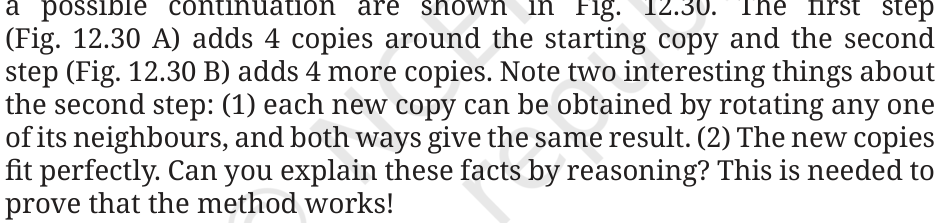
School Level Solution
11
Here is how one can tile! Recreate it with your pieces.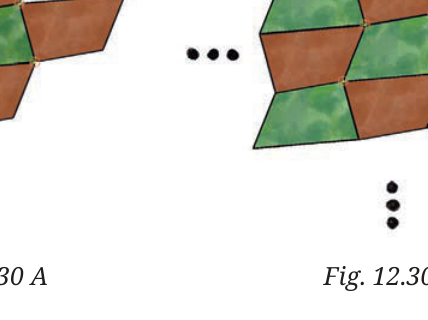
School Level Solution
12
How can we understand the figure? There seems to be a repeating pattern. (1) Can you precisely describe a procedure to draw the pattern so that someone can draw the tiling on their own, based only on your description? (2) Can you justify why your procedure works?
School Level Solution
Page 71(2 questions)
13
Now repeat this procedure at each edge of every copy of SOME that you add. Verify that this will result in a tiling! Two steps of a possible continuation are shown in Fig. 12.30. The first step (Fig. 12.30 A) adds 4 copies around the starting copy and the second step (Fig. 12.30 B) adds 4 more copies. Note two interesting things about the second step: (1) each new copy can be obtained by rotating any one of its neighbours, and both ways give the same result. (2) The new copies fit perfectly. Can you explain these facts by reasoning? This is needed to prove that the method works!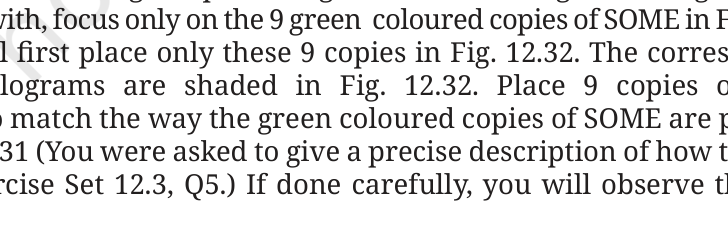
School Level Solution
14
Do you see which of the three possibilities shown in Fig. 12.27 occurs in the tiling?
School Level Solution
Page 72(3 questions)
15
Before we explain Method 2, let us conduct a thought experiment. Remember the Varignon parallelogram for 4-gons (Theorem 9). Imagine that we have drawn this parallelogram in each copy of SOME in the tiling shown earlier in Fig. 12.28. Visualise what the picture looks like. Fig. 12.31 shows the result. It appears that the Varignon parallelograms form a grid, giving the same parallelogram tiling we saw in the introduction!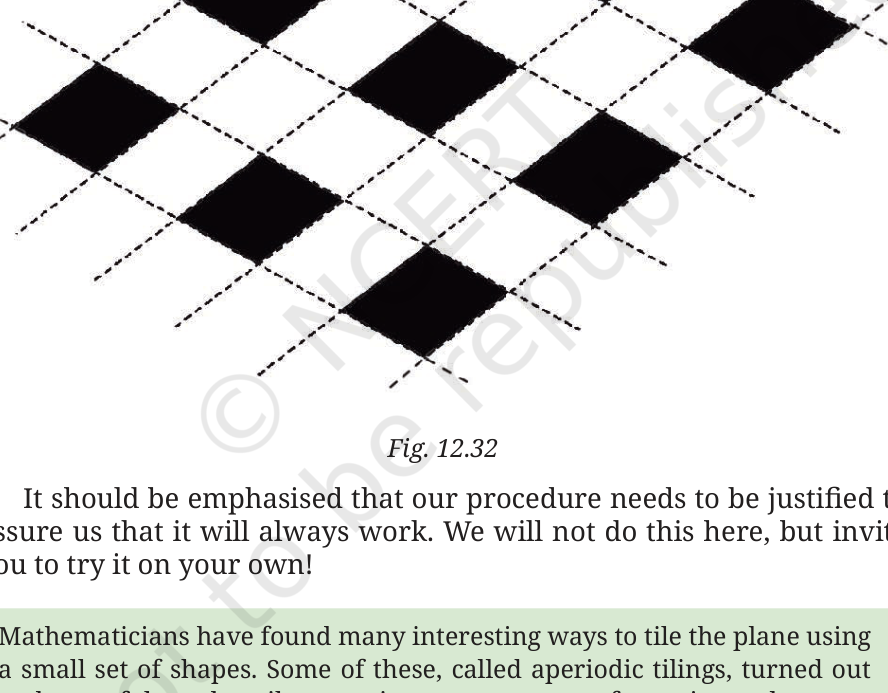
School Level Solution
16
This suggests an idea. What if we start by drawing just the simple grid tiling made by the Varignon parallelogram of SOME? Can we use this grid to construct the new tiling by SOME?
School Level Solution
17
A grid of Varignon parallelograms of SOME is given in Fig. 12.32. To begin with, focus only on the 9 green coloured copies of SOME in Fig. 12.31. We will first place only these 9 copies in Fig. 12.32. The corresponding parallelograms are shaded in Fig. 12.32. Place 9 copies of SOME so as to match the way the green coloured copies of SOME are placed in Fig. 12.31 (You were asked to give a precise description of how to do this in Exercise Set 12.3, Q5.) If done carefully, you will observe that each 4-gon you placed meets other placed copies exactly at vertices. Now see how 4 copies of SOME are made automatically in the gaps! Carefully place four more copies of SOME in these gaps. Continuing this process with more copies of SOME will give us the desired tiling.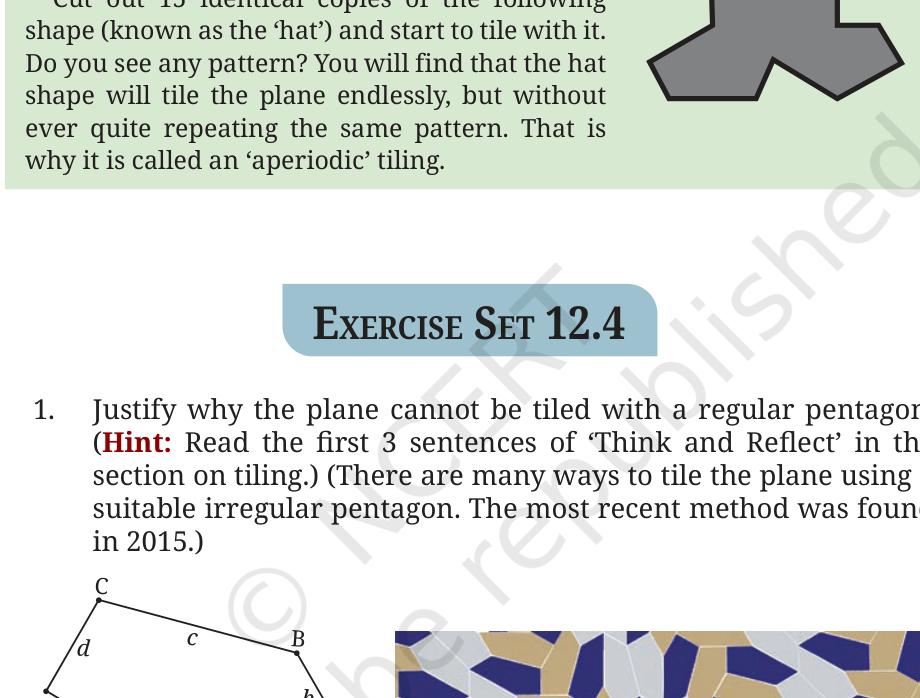
School Level Solution
Page 73(1 question)
18
It should be emphasised that our procedure needs to be justified to assure us that it will always work. We will not do this here, but invite you to try it on your own!
School Level Solution
Page 74(1 question)
19
A Cutting-edge DiscoveryThe following shape—the first of its kind!—that leads to aperiodic tilings was discovered only recently in 2023 by a team of four mathematicians (Smith, Myers, Kaplan and Goodman-Strauss).Cut out 15 identical copies of the following shape (known as the 'hat') and start to tile with it. Do you see any pattern? You will find that the hat shape will tile the plane endlessly, but without ever quite repeating the same pattern. That is why it is called an 'aperiodic' tiling.
School Level Solution